Sample course
Allergen awareness, written from one restaurant's own documents.
This is the course frunt wrote for our demo restaurant, [Your Restaurant], from its allergen matrix and its other documents. The restaurant is made up. The course is shown exactly as frunt generated it, with nothing edited, beside the same course in the staff app.
- Written from
- Its Allergen Matrix, and parts of its Food Safety & HACCP Procedure and Data Protection Policy
- Checked against
- Its matrix's 15 dishes: no contradictions
- The law
- Food Information Regulations 2014 + retained Regulation 1169/2011 Annex II (14 named allergens)
- Generated
- 27 October 2026, 6 sections and a final check of 10
Introduction
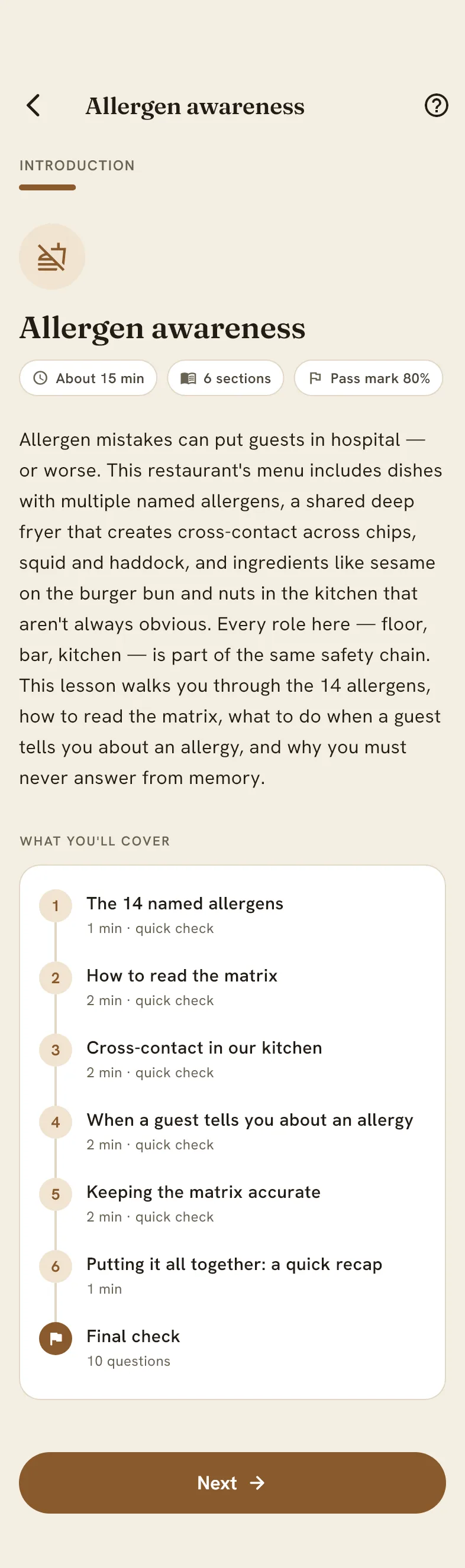
Allergen awareness
Allergen mistakes can put guests in hospital — or worse. This restaurant's menu includes dishes with multiple named allergens, a shared deep fryer that creates cross-contact across chips, squid and haddock, and ingredients like sesame on the burger bun and nuts in the kitchen that aren't always obvious. Every role here — floor, bar, kitchen — is part of the same safety chain. This lesson walks you through the 14 allergens, how to read the matrix, what to do when a guest tells you about an allergy, and why you must never answer from memory.
Section 1 of 6
The 14 named allergens
UK law names exactly 14 allergens that must be declared. These are the ones you will see in this restaurant's allergen matrix — and the only ones the law requires you to track and disclose.
Here they are:
- Celery (including celeriac)
- Cereals containing gluten (wheat, rye, barley, oats, spelt, kamut)
- Crustaceans (prawns, crabs, lobster, crayfish)
- Eggs
- Fish
- Lupin
- Milk (including lactose)
- Molluscs (mussels, oysters, squid)
- Mustard
- Peanuts
- Sesame
- Soybeans
- Sulphur dioxide / sulphites (above 10 mg/kg or 10 mg/L)
- Tree nuts (almonds, hazelnuts, walnuts, brazil nuts, cashew, pecan, pistachio, macadamia)
You don't need to memorise which dish contains which — that's what the matrix is for. But you do need to know these 14 by name, so you recognise them when a guest mentions one.
Where this comes from: Retained EU Regulation 1169/2011 Annex II (14 named allergens) · Food Information Regulations 2014 (UK SI 2014/1855)
Quick check
A guest says they have a 'wheat allergy'. Which of the 14 named allergens covers this?
- Lupin
- Cereals containing gluten
- Soybeans
- Celery
Show the answer
B. Cereals containing gluten Wheat is one of the cereals that contain gluten, so it falls under 'cereals containing gluten' — one of the 14 legally named allergens. Always treat a wheat allergy as a gluten allergen declaration and check the matrix accordingly.

Section 2 of 6
How to read the matrix
The allergen matrix is the only source of allergen information in this restaurant. Not memory. Not what you think a dish usually contains. Not what a chef mentioned last week. The matrix only.
Here's how to read it:
- Y (contains) — the allergen is an ingredient in the dish. Full stop.
- May (cross-contact) — the allergen is not an ingredient, but there is a known route by which it could get into the dish during preparation.
- Blank — the allergen is not an ingredient and there is no known cross-contact route.
A few examples from our menu:
- Wild mushroom soup contains celery, gluten and milk — three Y columns.
- Chips contain none of the 14 as ingredients, but may contain gluten, fish and molluscs because of the shared fryer.
- Dry-aged burger contains gluten, eggs, milk, mustard, sesame and sulphites — and may contain fish, molluscs and soybeans through cross-contact.
If a dish isn't in the matrix, or the matrix doesn't clearly answer the question, don't guess. Say you'll check, ask the head chef, and if it still can't be confirmed, don't serve it to that guest.
Where this comes from: Food Information Regulations 2014 (UK SI 2014/1855) · FSA allergen guidance for food businesses
Quick check
A guest asks if the chips contain fish. You check the matrix and see 'May' in the fish column. What does that mean?
- Fish is an ingredient in the chips recipe.
- The chips are probably fine for someone with a fish allergy.
- Fish is not an ingredient, but there is a known cross-contact route — in this case, the shared fryer.
- The matrix hasn't been checked for chips yet.
Show the answer
C. Fish is not an ingredient, but there is a known cross-contact route — in this case, the shared fryer. 'May' always means cross-contact risk, not an ingredient. Our chips share a fryer with the haddock and squid, so we cannot tell a guest with a fish allergy that the chips are safe.

Section 3 of 6
Cross-contact in our kitchen
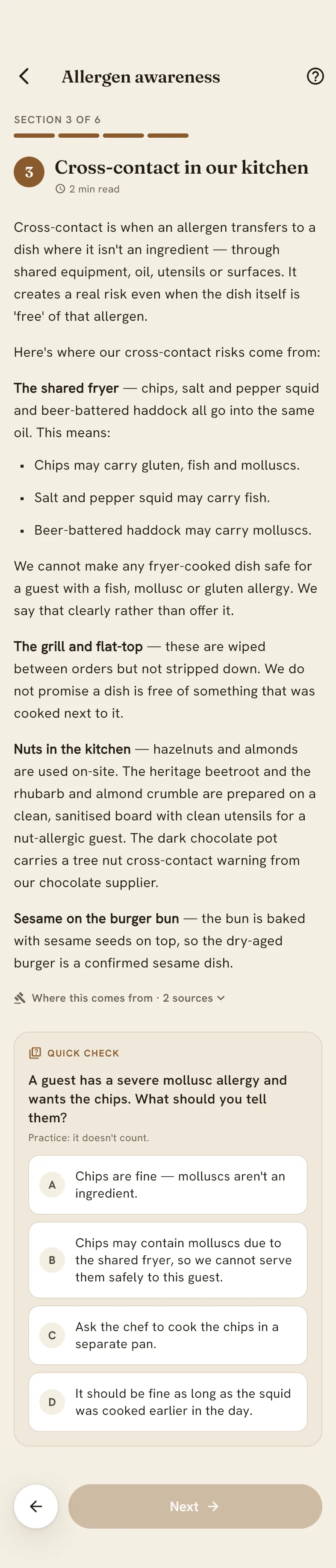
Cross-contact is when an allergen transfers to a dish where it isn't an ingredient — through shared equipment, oil, utensils or surfaces. It creates a real risk even when the dish itself is 'free' of that allergen.
Here's where our cross-contact risks come from:
The shared fryer — chips, salt and pepper squid and beer-battered haddock all go into the same oil. This means:
- Chips may carry gluten, fish and molluscs.
- Salt and pepper squid may carry fish.
- Beer-battered haddock may carry molluscs.
We cannot make any fryer-cooked dish safe for a guest with a fish, mollusc or gluten allergy. We say that clearly rather than offer it.
The grill and flat-top — these are wiped between orders but not stripped down. We do not promise a dish is free of something that was cooked next to it.
Nuts in the kitchen — hazelnuts and almonds are used on-site. The heritage beetroot and the rhubarb and almond crumble are prepared on a clean, sanitised board with clean utensils for a nut-allergic guest. The dark chocolate pot carries a tree nut cross-contact warning from our chocolate supplier.
Sesame on the burger bun — the bun is baked with sesame seeds on top, so the dry-aged burger is a confirmed sesame dish.
Where this comes from: FSA allergen guidance for food businesses · Food Information Regulations 2014 (UK SI 2014/1855)
Quick check
A guest has a severe mollusc allergy and wants the chips. What should you tell them?
- Chips are fine — molluscs aren't an ingredient.
- Chips may contain molluscs due to the shared fryer, so we cannot serve them safely to this guest.
- Ask the chef to cook the chips in a separate pan.
- It should be fine as long as the squid was cooked earlier in the day.
Show the answer
B. Chips may contain molluscs due to the shared fryer, so we cannot serve them safely to this guest. Our chips share a fryer with the squid, which contains molluscs. The matrix shows chips 'may contain' molluscs. We cannot make the chips safe for a mollusc-allergic guest and must say so honestly.
Section 4 of 6
When a guest tells you about an allergy
This is the moment that matters most. Here's exactly what to do — in order:
- Thank them and take it seriously. Never say 'it should be fine' or 'I think that's okay'.
- Tell the duty manager and the head chef (or chef on the pass) straight away — before the order goes in. Don't wait.
- Write the allergy in capitals on the ticket and flag it on the till. Verbal-only is not enough.
- Check every dish the guest wants against the matrix — not from memory. If a dish isn't in the matrix or the matrix doesn't clearly answer, say you'll check. If it still can't be confirmed, do not serve it.
- The kitchen cooks the order on cleaned equipment with clean utensils and plates it separately.
- You — the person who took the order — carry the dish to the table and confirm with the guest by naming the allergen. Don't pass it through a runner where confusion can creep in.
- If the guest becomes unwell, call 999 immediately for any sign of a severe reaction: swelling of the lips or throat, difficulty breathing, collapse. Tell the duty manager at once.
This sequence exists because every step is a checkpoint. Skipping one creates a gap.
Where this comes from: Food Information Regulations 2014 (UK SI 2014/1855) · FSA allergen guidance for food businesses
Quick check
A guest mentions a nut allergy as you take their order. You've checked the matrix and their chosen dishes look safe. What must you do before the food goes to the kitchen?
- Note it mentally and make sure the chef knows verbally when the order comes through.
- Write the allergy in capitals on the ticket, flag it on the till, and tell the duty manager and head chef straight away.
- Inform the duty manager after service so it can be logged.
- Ask the guest to speak to the chef themselves.
Show the answer
B. Write the allergy in capitals on the ticket, flag it on the till, and tell the duty manager and head chef straight away. The allergy must be written on the ticket and flagged on the till — verbal communication alone is not enough. The duty manager and head chef must also be told before the order goes in. Every step in the sequence is required.

Section 5 of 6
Keeping the matrix accurate
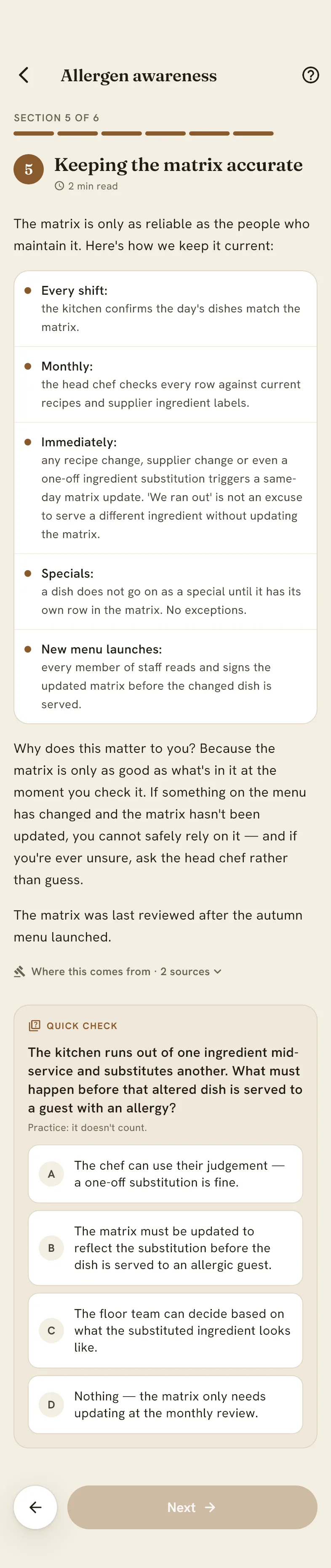
The matrix is only as reliable as the people who maintain it. Here's how we keep it current:
- Every shift: the kitchen confirms the day's dishes match the matrix.
- Monthly: the head chef checks every row against current recipes and supplier ingredient labels.
- Immediately: any recipe change, supplier change or even a one-off ingredient substitution triggers a same-day matrix update. 'We ran out' is not an excuse to serve a different ingredient without updating the matrix.
- Specials: a dish does not go on as a special until it has its own row in the matrix. No exceptions.
- New menu launches: every member of staff reads and signs the updated matrix before the changed dish is served.
Why does this matter to you? Because the matrix is only as good as what's in it at the moment you check it. If something on the menu has changed and the matrix hasn't been updated, you cannot safely rely on it — and if you're ever unsure, ask the head chef rather than guess.
The matrix was last reviewed after the autumn menu launched.
Where this comes from: Food Information Regulations 2014 (UK SI 2014/1855) · FSA allergen guidance for food businesses
Quick check
The kitchen runs out of one ingredient mid-service and substitutes another. What must happen before that altered dish is served to a guest with an allergy?
- The chef can use their judgement — a one-off substitution is fine.
- The matrix must be updated to reflect the substitution before the dish is served to an allergic guest.
- The floor team can decide based on what the substituted ingredient looks like.
- Nothing — the matrix only needs updating at the monthly review.
Show the answer
B. The matrix must be updated to reflect the substitution before the dish is served to an allergic guest. Even a one-off ingredient substitution can introduce a new allergen. The matrix must be updated before the dish goes out to any guest who has declared an allergy. When in doubt, don't serve it until the head chef has confirmed.
Section 6 of 6
Putting it all together: a quick recap
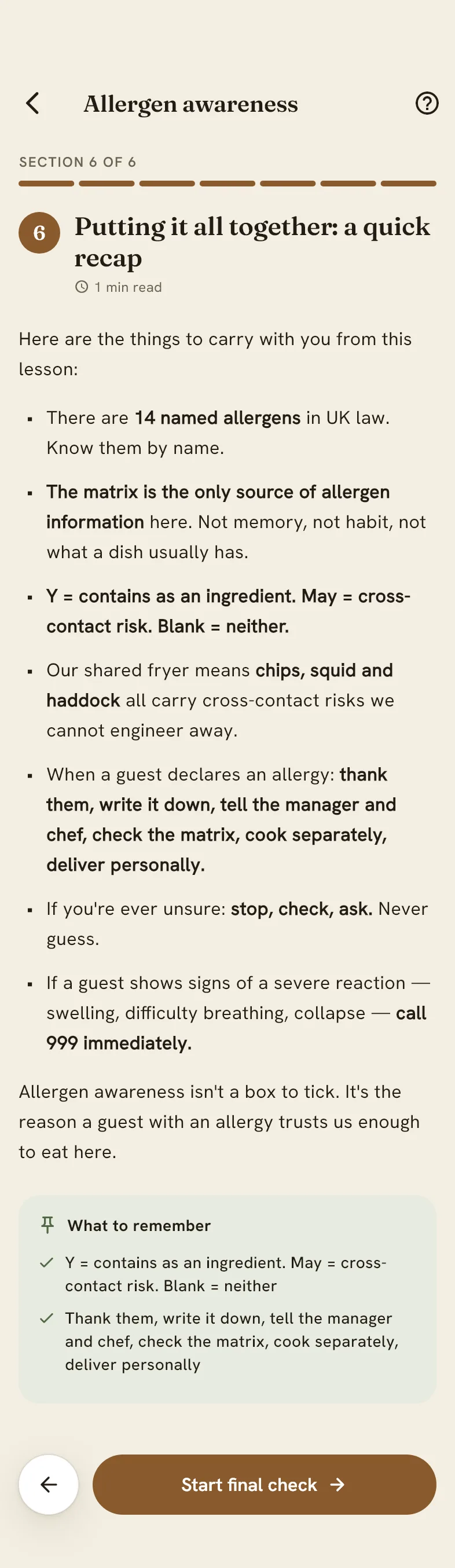
Here are the things to carry with you from this lesson:
- There are 14 named allergens in UK law. Know them by name.
- The matrix is the only source of allergen information here. Not memory, not habit, not what a dish usually has.
- Y = contains as an ingredient. May = cross-contact risk. Blank = neither.
- Our shared fryer means chips, squid and haddock all carry cross-contact risks we cannot engineer away.
- When a guest declares an allergy: thank them, write it down, tell the manager and chef, check the matrix, cook separately, deliver personally.
- If you're ever unsure: stop, check, ask. Never guess.
- If a guest shows signs of a severe reaction — swelling, difficulty breathing, collapse — call 999 immediately.
Allergen awareness isn't a box to tick. It's the reason a guest with an allergy trusts us enough to eat here.
Final check
10 questions. Passing it is the record.
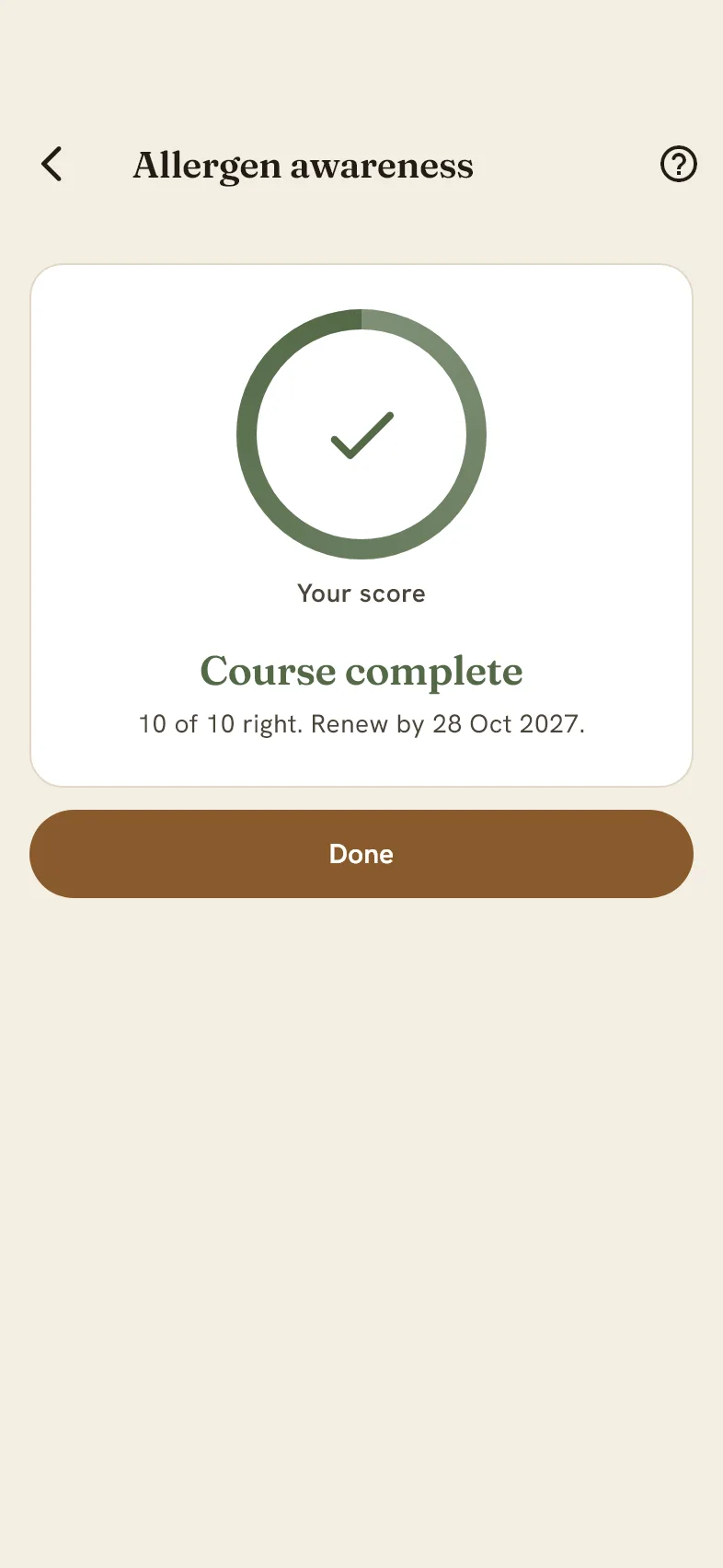
A staff member who passes gets a dated record the manager sees, with the course version and their score, and the course comes round again when it's due or when the matrix changes.
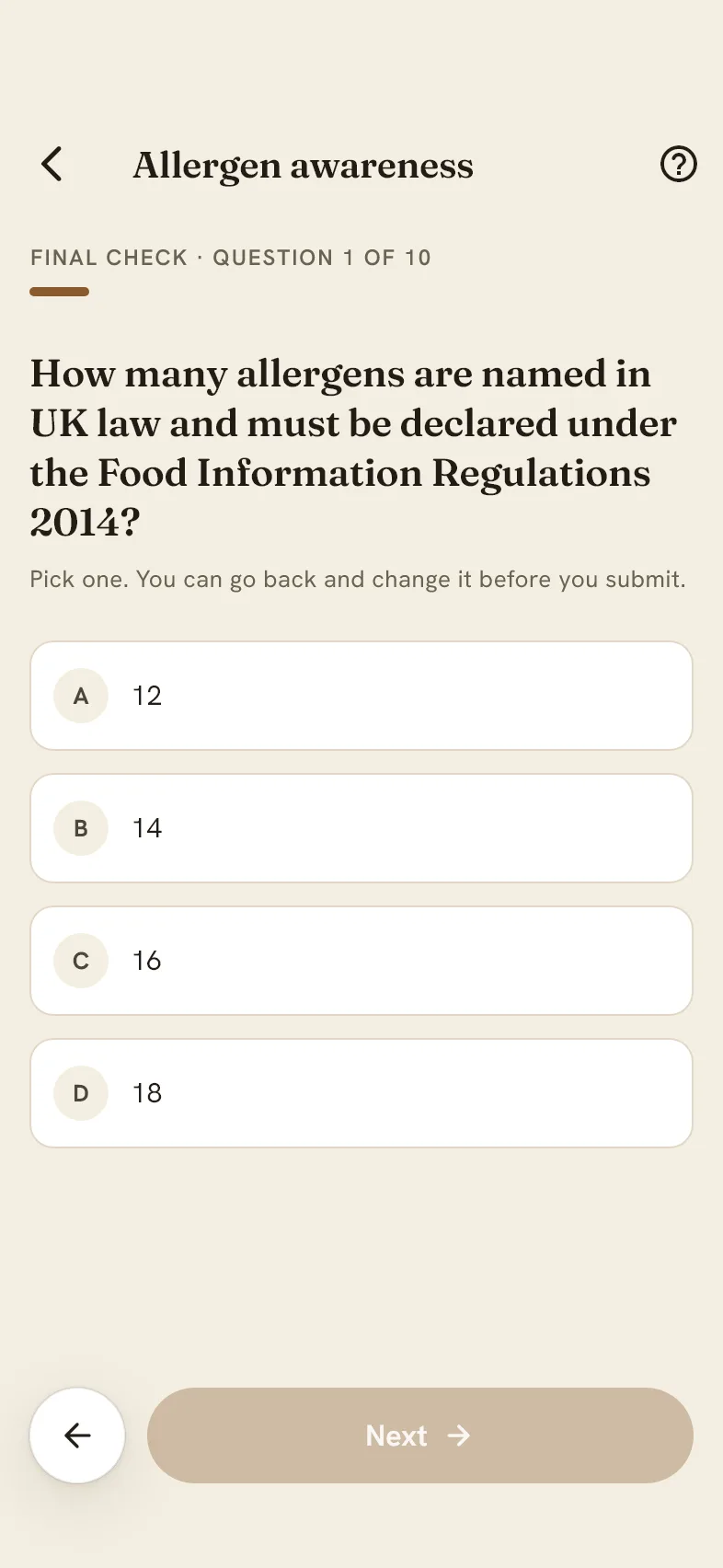
1.How many allergens are named in UK law and must be declared under the Food Information Regulations 2014?
- A12
- B14
- C16
- D18
Show the answer
B. 14
2.Which of the following is correctly listed as one of the 14 named allergens under UK law?
- ACorn / maize
- BLupin
- CGarlic
- DChilli
Show the answer
B. Lupin
3.A guest asks whether the chips are safe for someone with a fish allergy. What is the correct answer?
- AYes — chips contain no fish as an ingredient so they are safe.
- BProbably fine — the oil is changed regularly.
- CNo — chips go in the same fryer as the haddock and squid, so they may contain fish and we cannot make them safe for a fish allergy.
- DIt depends on the time of day and what has been cooked earlier.
Show the answer
C. No — chips go in the same fryer as the haddock and squid, so they may contain fish and we cannot make them safe for a fish allergy.
4.In the allergen matrix, what does 'May' in a cell mean?
- AThe allergen is a confirmed ingredient in the dish.
- BThe allergen is not an ingredient but there is a known cross-contact route in our kitchen.
- CThe dish has not yet been checked against that allergen.
- DThe dish sometimes contains the allergen depending on the recipe version used.
Show the answer
B. The allergen is not an ingredient but there is a known cross-contact route in our kitchen.
5.A guest tells you they have a mustard allergy and are considering the beer-battered haddock. You check the matrix. What does it tell you?
- ABeer-battered haddock is blank for mustard — it is safe to serve.
- BBeer-battered haddock contains mustard as an ingredient — do not serve it to this guest.
- CBeer-battered haddock may contain mustard through cross-contact only — so it can be served with a warning.
- DThe matrix does not include mustard as a column, so you must ask the chef.
Show the answer
B. Beer-battered haddock contains mustard as an ingredient — do not serve it to this guest.
6.A guest declares a tree nut allergy and wants the dark chocolate pot. What is correct according to the matrix?
- AThe dark chocolate pot contains no tree nuts as an ingredient and has no cross-contact risk — it is safe.
- BThe dark chocolate pot contains tree nuts as a confirmed ingredient.
- CThe dark chocolate pot does not contain tree nuts as an ingredient but may contain them through cross-contact — you cannot guarantee it is free.
- DTree nuts are not relevant to the dark chocolate pot; the concern is soybeans.
Show the answer
C. The dark chocolate pot does not contain tree nuts as an ingredient but may contain them through cross-contact — you cannot guarantee it is free.
7.A guest tells you about their allergy at the table. What is the correct first step?
- AGo straight to the kitchen and tell the chef.
- BThank the guest, take it seriously, and never say 'it should be fine'.
- CCheck the allergen matrix before saying anything to the guest.
- DFlag it on the till so there is a written record.
Show the answer
B. Thank the guest, take it seriously, and never say 'it should be fine'.
8.After checking the matrix and confirming a dish is suitable, who should carry the allergen order to the table?
- AAny available runner — speed matters more than who delivers it.
- BThe head chef, to give the guest confidence.
- CThe person who took the order, who confirms the allergen with the guest by name.
- DThe duty manager, as they hold overall responsibility.
Show the answer
C. The person who took the order, who confirms the allergen with the guest by name.
9.A guest with a gluten allergy is unwell at the table and shows swelling of the lips and difficulty breathing. What must you do immediately?
- AOffer them water and monitor the situation for a few minutes before escalating.
- BCall 999 and tell the duty manager at once.
- CAsk the guest if they have an EpiPen before taking any other action.
- DInform the head chef and complete an incident report.
Show the answer
B. Call 999 and tell the duty manager at once.
10.The kitchen runs out of the usual burger bun mid-service and switches to a different bun without telling anyone. What must happen before that burger is served to any guest?
- AThe chef can use their judgement — a bun swap is a minor change.
- BThe matrix must be updated the same day to reflect the ingredient substitution before the dish is served.
- CA note should be made at the end of service and the matrix updated at the next monthly review.
- DThe front-of-house team should be told verbally so they can advise guests.
Show the answer
B. The matrix must be updated the same day to reflect the ingredient substitution before the dish is served.
Every course frunt writes works the same way.
Each topic starts from frunt's template of what UK law and the regulators expect, and is written from the matching document of yours: the one you've checked and adopted. A restaurant needs only the topics that apply to it, and you read each course before your team does.
| Course | Written from your | Where the duty comes from |
|---|---|---|
| Food hygiene | Food safety SOP | Regulation 852/2004 Annex II Ch XII §1 |
| Allergen awareness | Allergen matrix | Food Information Regulations 2014 + retained Regulation 1169/2011 Annex II (14 named allergens) |
| Natasha's Law (PPDS labelling) | Allergen matrix | Food Information (Amendment) (England) Regulations 2019 (PPDS full-ingredient + allergen labelling) |
| HACCP / SFBB awareness | Food safety SOP | Regulation 852/2004 Art 5 + Annex II Ch XII §2 (HACCP-based permanent procedure) |
| Health & safety induction | Health & safety record | Health and Safety at Work etc Act 1974 s.2(2)(c) + Management Regs 1999 reg 13 |
| Fire safety awareness | Fire safety procedure | Regulatory Reform (Fire Safety) Order 2005 Art 21 (training of employees) |
| COSHH / chemical safety | COSHH assessment | Control of Substances Hazardous to Health Regulations 2002 reg 12 (information, instruction, training) |
| Manual handling | Manual handling assessment | Manual Handling Operations Regulations 1992 reg 4 (avoid / assess / reduce risk) |
| Anti-harassment & dignity at work | HR policy | Worker Protection (Amendment of Equality Act 2010) Act 2023 |
| Responsible alcohol service (Challenge 25) | Alcohol service policy | Licensing Act 2003 s.19 |
| Data protection awareness | Data protection policy | ICO accountability expectation |
Trained on your restaurant, not a generic one.
Your dishes, by name.
It names the dishes on your menu and what's in them, from your own matrix: not a list of allergens in the abstract.
Your kitchen's real risks.
The shared fryer, where nuts are used, what the bun is baked with: the things your documents say about how your kitchen works.
Your rules, in your order.
What staff do when a guest mentions an allergy is your procedure, step by step, with the law it answers to.
Checked before anyone reads it.
Every allergen statement is checked in code against your matrix. A course that contradicts it can't be published: frunt writes a new draft instead.
Kept current.
Change the menu or the matrix and the course follows. Staff who already passed get a short refresher on what changed.
frunt's courses aren't accredited, and work alongside a Level 2 food hygiene course rather than replacing it. Training and the law says what the law asks for.
On a walkthrough we show you a course written from your own documents. Or look round the demo restaurant.